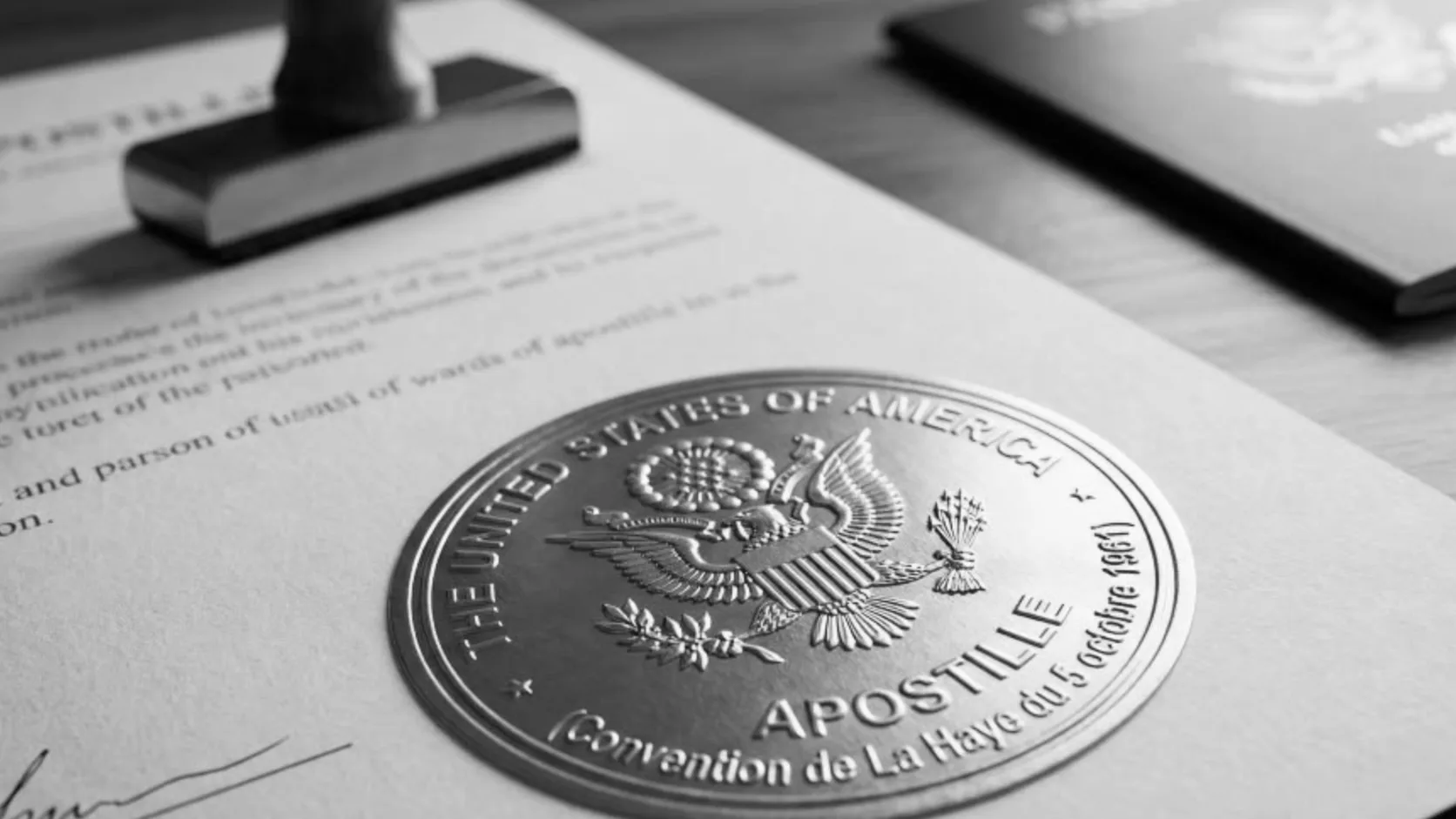
A credential evaluation is a report stating what a foreign qualification corresponds to in the receiving country’s own system: which local diploma it matches and what it gives access to. It is one of three separate procedures that are routinely confused. An apostille confirms that the stamp and signature on a document are genuine, and works only between parties to the 1961 Hague Convention, of which there were 130 on 30 June 2026. A sworn or certified translation confirms that the text is accurate, and the receiving country sets who may produce it: uni-assist accepts translations from Russia only where a Russian notary has attested the translator’s signature. The evaluation answers a different question from either, and none of the three substitutes for another. Who issues it varies by country: UK ENIC in the United Kingdom, a NACES member agency such as World Education Services in the United States, the university itself in the Netherlands. Start with the evaluation, because it determines whether you enter directly or through an additional year.
- An apostille is issued by the competent authority of the country that issued the document, and only for parties to the Hague Convention (130 on 30 June 2026). Within the EU, education documents are often exempt from legalisation altogether.
- A sworn translation is a separate procedure. uni-assist accepts translations from sworn or court-admissible translators, and for Russia additionally requires a notary to attest the translator’s signature; translations from ordinary agencies are not accepted.
- Recognition is decided by the university. In Italy the MUR circular for 2026/27 and 2027/28 requires a secondary certificate obtained over at least 12 years of schooling, and leaves a CIMEA statement or a Dichiarazione di Valore to the institution’s discretion.
- Italian institutions are asked not to require a Dichiarazione di Valore from students who need no visa: the document is issued by a consulate, and a visa-exempt applicant never approaches one.
- In the Netherlands the bar is expressed in level rather than stamps: Radboud accepts the Russian school certificate with a mark of 5 in every subject plus a Unified State Exam result of 70 in four subjects, with mathematics at advanced level.
- The order of work is the reverse of the intuitive one: establish the level of recognition first, then translate and legalise. An apostille on a document that does not give direct access is money and weeks spent for nothing.
Three procedures answering three different questions
Families usually arrive with a single phrase: the documents need certifying. Behind it sit three independent procedures, and they are not interchangeable. Each answers its own question, and each is carried out by a different body.
| Procedure | Question it answers | Who carries it out |
|---|---|---|
| Apostille or consular legalisation | Are the stamp and signature on the document genuine | The competent authority of the issuing country |
| Sworn or certified translation | Is the text accurate in the language of the receiving country | A translator entitled to do so under the receiving country’s rules |
| Recognition of the qualification | What the document corresponds to in the local education system | The university or the national ENIC-NARIC centre |
The apostille: what it is and where it works
The 1961 Hague Convention replaced the long consular chain with a single certificate issued by an authority in the country where the document originates. On 30 June 2026 the Convention had 130 Contracting Parties, and it remains one of the most widely applied multilateral treaties in this field.
Two practical consequences follow. First, an apostille is possible only where both countries are parties. Where the destination is not on the list, the older scheme applies, with successive attestations through ministries and a consulate. Second, the apostille is issued by the country that issued the document, not by the country you are moving to.
The electronic apostille deserves separate mention. The HCCH states it plainly: an e-Apostille cannot be refused simply because it was issued in digital form. The same rules and procedures apply as for a paper one, and every Contracting Party must accept it.
An apostille confirms a signature and a seal. It says nothing about the content of the document, still less about the level of education behind it.
Where no apostille is needed
A common assumption is that an apostille is always needed, on everything. Within the European Union the requirement is frequently lighter. UNEDasiss, the Spanish service through which international applicants reach Spanish universities, puts it directly: documents issued in EU member states are exempt from legalisation. An apostille is required for documents from Hague Convention countries outside the EU, and a four-step consular route applies to the rest.
There is also a case that is rarely written about. The Italian circular issued by the Ministry of Universities and Research for 2026/27 and 2027/28 asks institutions not to require a Dichiarazione di Valore from international students who do not need a visa: such an applicant never approaches a consulate, and requiring a consular document of them serves no purpose.
Sworn translation: who is entitled to translate
The second most common formal refusal concerns a translation made by the wrong person. In most systems an ordinary translation agency does not qualify, and this is said openly.
uni-assist, through which international applications to German universities pass, accepts translations from two sources: persons or institutions authorised to translate under oath or admissible in court, and a department of the issuing school or university authorised to issue such translations. It does not accept uncertified translations from standard translation agencies.
For Russia uni-assist sets a stricter rule of its own. Translations from Russia are accepted only where a Russian notary has attested the signature and identity of the translator. The requirement applies to translations produced by an agency as well.
| Where you apply | Into which language | Who may translate |
|---|---|---|
| Germany, uni-assist | German or English | A sworn or court-admissible translator; for Russia, additionally a notarial attestation of the translator’s signature |
| Spain, UNEDasiss | Spanish | A Spanish diplomatic or consular mission abroad, or the mission of the issuing country in Spain |
| Italy, universities | Italian | The MUR circular calls for translations where required; the precise requirement is set by the university |
| United Kingdom, UCAS | English | An official translation of qualification certificates is uploaded in the Education section |
One detail about Germany is often lost. It is not only the degree certificate that must be translated, but the transcript of subjects and marks. uni-assist requires documents to be uploaded in their entirety, including every page and the Diploma Supplement, and does not accept sets from which anything has been omitted.
There is a further requirement that applicants from Russia tend to discover late. uni-assist separately asks for an official document setting out the grading system used by your university, such as the examination regulations. Links to anabin or Wikipedia are expressly described as insufficient. Academic records issued from 2016 onwards must show the credit points earned.
Recognition: the question asked last
The third procedure answers the question that should come first: what your document is worth in the local system. The answer determines not the paperwork but the length of the whole route.
Russian-speaking applicants often call this nostrification. The term comes from countries where recognition is granted by a separate state act: Czechia, Serbia and Slovakia work that way. Germany, Italy and the Netherlands have no separate nostrification at all — the university decides, drawing on recognition databases and the statements of national centres. Looking for a body that will “nostrify” a certificate in those countries wastes weeks, and it is the first fork where applicants lose them.
The Italian circular for 2026/27 and 2027/28 states the base requirement for first-cycle entry as a final secondary qualification obtained over at least 12 years of schooling. Where the period is shorter, a separate annex to the circular applies. Russian schooling runs for eleven years, and that is where the gap arises, closed either by years at university or by additional procedures.
In the Netherlands the bar is more specific still. Radboud University lists, for Russia, the school certificate with a mark of 5 in every subject plus a Unified State Exam result of 70 in four subjects, with mathematics at advanced level. Nuffic, the Dutch centre for diploma comparison, places the Russian school certificate at HAVO level or above, while a research university requires VWO.
| Country | Body or instrument | Is it compulsory |
|---|---|---|
| Germany | anabin, the KMK database, checked through uni-assist | The anabin status determines direct access |
| Italy | The university; CIMEA or a Dichiarazione di Valore | At the institution’s discretion, MUR circular 2026/27 |
| Spain | UNEDasiss accreditation, issued by UNED | Generally yes for undergraduate access |
| Netherlands | The university itself, using country lists; Nuffic as reference | The institution decides |
| United Kingdom | UK ENIC, Statement of Comparability | A chargeable service, not always needed |
| United States | NACES member agencies, for example WES | Set by the individual university |
The British and American routes share a feature worth understanding in advance. UK ENIC states plainly that the Statement of Comparability is a chargeable service and that the fee covers the evaluation rather than the outcome; it is non-refundable once review has begun, even where it emerges that you are not eligible. The Statement does not comment on grades, grade comparisons, specific subjects or English proficiency.
The United States has no government recognition body at all. NACES, the association of credential evaluation services, performs no evaluations itself: it brings together agencies working to its standards. Which of them applies is determined by the university’s requirement, not by an agency’s reputation.
What a credential evaluation report contains
A credential evaluation report states what a foreign qualification corresponds to locally. In its simplest form it names the equivalent local diploma; a course-by-course report additionally lists subjects, credit hours and converted grades, which is what American universities usually ask for when transfer credit is at stake. The report is an opinion addressed to the institution, not a licence: the university decides what to do with it, and two agencies can reach different conclusions about the same certificate.
Two practical consequences follow. Order the report the university names, not the one that appears first in search results, because an evaluation from an agency the institution does not accept has to be bought again. And check the requirement before paying: UK ENIC states that its Statement of Comparability fee covers the evaluation rather than the outcome, and is non-refundable once review has begun.
Timing: why this is counted backwards
The three procedures run in sequence, and each takes weeks. They are counted backwards from the application deadline, not forwards from the day a family decided.
As at 14 September 2026 uni-assist states processing of 3 to 4 weeks for Central and Eastern Europe and 4 to 6 weeks in general, and recommends applying at least eight weeks before the university’s deadline so that it can report missing documents in time. For many programmes the deadline is 15 July for the winter semester and 15 January for the summer semester, though individual courses and the Studienkolleg fall earlier.
Italy carries a further deadline that lives apart from university admission. Visa applications for the 2026/27 academic year are submitted to the consulate no later than 30 November 2026, and for 2027/28 no later than 31 October 2027. The circular warns separately that universities may publish earlier dates on their own portals, and those dates then govern.
| Step | Indicative duration | Depends on |
|---|---|---|
| Apostille on an education document | Weeks, depending on the authority and the year of issue | The competent authority of the issuing country |
| Sworn translation with attestation | Days to weeks | Availability of an authorised translator |
| uni-assist review | 3 to 6 weeks | Region of issue and completeness of the set |
| University decision | Weeks to months | The programme and the admissions cycle |
The order that saves a cycle
- Establish the level of recognition. Check the status of the qualification: anabin for Germany, the country lists published by Dutch universities, the MUR circular for Italy, the programme’s own requirements elsewhere.
- Establish what the programme actually requires. An ENIC-NARIC statement is not needed everywhere: in Italy it is left to the institution, and universities are asked not to require a Dichiarazione di Valore from visa-exempt applicants.
- Check whether legalisation is needed at all. Documents from EU states are often exempt, and an apostille works only between parties to the Hague Convention.
- Establish the translator requirement before ordering a translation. For Russian documents in Germany a notarial attestation of the translator’s signature is required, and an ordinary agency does not meet it.
- Assemble the set in full. The degree certificate, the transcript of marks, every page, and the official document on the university’s grading system.
- Count the calendar backwards, allowing 3 to 6 weeks of processing and the recommendation to apply eight weeks before the deadline.
Frequently asked questions
Is an apostille needed on a school certificate to apply abroad?
Not always. An apostille works only between parties to the 1961 Hague Convention, of which there were 130 on 30 June 2026. Documents from EU states are frequently exempt from legalisation altogether: the Spanish service UNEDasiss states directly that documents issued in EU member states require none. Check the requirement of the particular programme before paying for the procedure.
What is nostrification, and is it required?
It is the term Russian-speaking applicants use for recognition of a foreign qualification. It is not a separate procedure everywhere: in Czechia, Serbia and Slovakia it is a state act, while in Germany, Italy and the Netherlands the university itself decides, drawing on recognition databases and ENIC-NARIC statements. The question to ask is therefore not where to obtain nostrification but who decides recognition in that country.
How does an apostille differ from recognition of a qualification?
They are different things. An apostille confirms that the stamp and signature on a document are genuine and says nothing about the level of education. Recognition answers what your qualification corresponds to in the local system, and that is decided by the university or the national ENIC-NARIC centre. An apostilled certificate may still fail to give direct access to undergraduate study.
Will a translation from an ordinary translation agency be accepted?
Generally not. uni-assist accepts translations from sworn or court-admissible translators, or from a department of the issuing institution, and expressly does not accept uncertified translations from standard agencies. For documents from Russia a separate rule applies: a Russian notary must attest the signature and identity of the translator, and this covers agency translations too.
What is a Dichiarazione di Valore, and does everyone need one?
It is a document issued by an Italian consulate describing the standing of a foreign qualification. The MUR circular for 2026/27 and 2027/28 leaves it to the university’s discretion alongside a CIMEA statement, and separately asks institutions not to require it from students who need no visa, since such an applicant never approaches a consulate.
Is a Russian school certificate enough for admission in the Netherlands?
It depends on the university and its requirements. Radboud University lists, for Russia, the school certificate with a mark of 5 in every subject plus a Unified State Exam result of 70 in four subjects, including mathematics at advanced level. Nuffic places the Russian certificate at HAVO level or above, while a research university requires VWO.
What does credential evaluation mean?
It means establishing what a qualification earned in one country corresponds to in another: which local diploma it matches and what it gives access to. The report is produced by a designated body — UK ENIC in the United Kingdom, a NACES member agency such as World Education Services in the United States, the university itself in the Netherlands — and it is separate from an apostille, which confirms a signature, and from a sworn translation, which confirms the text.
Is WES the same as NACES?
No. NACES is the association; World Education Services is one of its member agencies, a member since March 1987. NACES performs no evaluations of its own and gives no guidance on individual cases. The university states which agency it accepts, and that requirement decides which report to order.
Is a credential evaluation compulsory for the United States?
The United States has no government recognition body. The requirement comes from the university itself, which also states which agency it accepts. NACES brings together agencies working to its standards, but performs no evaluations and offers no guidance on individual cases.
How long does preparing the documents take?
Plan in months. uni-assist states processing of 3 to 6 weeks and recommends applying at least eight weeks before the university’s deadline, and the apostille and translation come on top of that. Italy carries a separate visa deadline: 30 November 2026 for the 2026/27 academic year and 31 October 2027 for 2027/28, with universities entitled to publish an earlier date.
Are electronic apostilles accepted?
Yes. The HCCH states it directly: an e-Apostille cannot be refused simply because it was issued in digital form. The same rules apply as for a paper apostille, and every Contracting Party must accept it.
EDMONT supports applications to universities in continental Europe, including choosing universities and programmes, and checks requirements against the official sources for the current cycle. We establish the level of recognition before document preparation begins, determine which procedures your programme genuinely requires, and build the calendar so that legalisation and translation do not sit on the critical path.