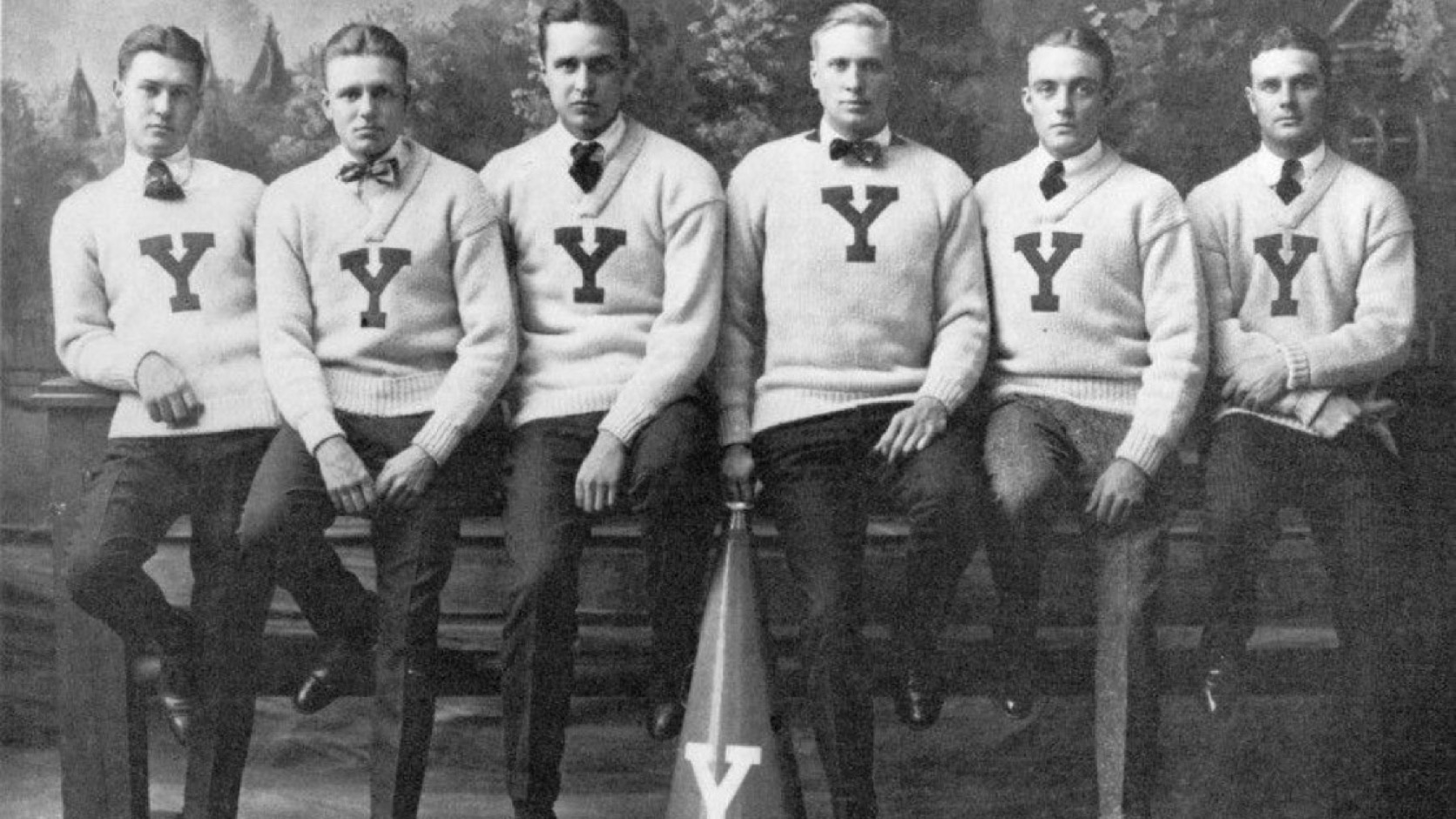
"Oxford, Harvard, the Ivy League" is how the summit of world education is usually described, everything listed in one line. Three mistakes hide in that line. The Ivy League is not a ranking or a mark of quality but an athletic conference of eight American universities. Oxford is not part of it and cannot be: it is in another country. And Harvard and Oxford are built so differently that a candidate who suits one often does not suit the other.
The Ivy League: an agreement about sport, not about scholarship
In 1954 the presidents of eight universities extended the Ivy Group Agreement — until then confined to football — to every intercollegiate sport. Regular round-robin competition began in 1956. The Ivy League remains what it was designed to be: an athletic conference in NCAA Division I.
The purpose of the agreement was the opposite of what the name now suggests. The universities were not asserting superiority but accepting limits: common eligibility rules, and a ban on athletic scholarships and post-season contests, so that college sport would not turn professional and the athlete would remain a student like any other. The ban on athletic scholarships still holds.
The origin of the name itself has never been established. One account traces it to the tradition of planting ivy at the old universities of the north-east; another to the Roman numeral IV, on the theory that the original grouping had four members. Neither is documented.
- Harvard — 1636
- Yale — 1701
- University of Pennsylvania — 1740
- Princeton — 1746
- Columbia — 1754
- Brown — 1764
- Dartmouth — 1769
- Cornell — 1865
Seven of the eight were founded before the American Revolution, which makes them older than the United States. There is one exception: Cornell, established in 1865, almost two centuries after the rest.
A practical conclusion follows from those athletic origins: membership of the Ivy League says nothing about academic standing. MIT, Stanford, the University of Chicago, Caltech and Duke are not members, and in subject rankings they regularly finish ahead of those that are. "Not Ivy League" does not mean weaker; it means playing in a different athletic conference.
Eight universities, each built differently
A list of eight names explains nothing, and the differences between them run deeper than is generally assumed. These are not eight versions of the same institution: each has its own undergraduate architecture, its own scale and its own idea of what should be taught and how.
| University | Founded | What sets it apart |
|---|---|---|
| Harvard | 1636 | The largest university endowment in the world — $56.9 billion |
| Yale | 1701 | Fourteen residential colleges modelled on Oxford and Cambridge |
| Pennsylvania | 1740 | Wharton, the world's first collegiate business school |
| Princeton | 1746 | No medical, law or business school at all |
| Columbia | 1754 | The Core Curriculum, compulsory for every undergraduate |
| Brown | 1764 | The Open Curriculum, with no required subjects whatever |
| Dartmouth | 1769 | The smallest; a year of four ten-week terms |
| Cornell | 1865 | The largest, and the only land-grant institution in the League |
Two of the eight rest on directly opposing ideas, which is the clearest illustration of how uneven the League is. Columbia runs the Core Curriculum: a set of seminars in literature, philosophy, history and the sciences that every undergraduate takes regardless of their field. Brown runs the Open Curriculum: no core, no distribution requirements. A degree calls for thirty courses, the requirements of a chosen concentration and demonstrated competence in writing; the rest the student assembles alone. Any course may be taken satisfactory / no credit, and Brown keeps neither a grade point average nor a class ranking.
Princeton is the only member with no medical school, and it has no law or business school either. Its resources sit with the undergraduates, and nearly every student graduates having produced a piece of independent research: the senior thesis here is written not by a selected few but by almost everyone.
Dartmouth is the smallest, with roughly 4,400 undergraduates, and keeps a calendar of its own. The D-Plan divides the year into four ten-week terms including a summer one; students must be enrolled for three of the four, and one summer on campus is compulsory. Cornell is the opposite pole: some 15,000 undergraduates and the League's only land-grant status, meaning obligations to the state. Its founder Ezra Cornell put the intention this way: an institution where any person can find instruction in any study.
Closest to the British model is Yale. Since 1933 its undergraduates have been distributed among fourteen residential colleges, organised and built after the Oxford and Cambridge pattern. A first-year student is assigned to a college at random and remains a member of it through to graduation.
The University of Pennsylvania traces itself to a plan set out by Benjamin Franklin in 1749, and its Wharton School, opened in 1881, was the first business school within a university anywhere in the world.
Harvard is the oldest and the best provided for: its fund, the largest university endowment in the world, stood at $56.9 billion at the close of the 2025 financial year and supplies more than a third of the university's revenue. This is not a footnote. Out of that money $784 million in financial aid was awarded in the same year — which is precisely why Harvard can afford the rules described further on.
Oxbridge: five centuries older than Harvard, and born of an escape
Oxford has no date of foundation. All that is known is that teaching of some kind was going on there by 1096. Rapid growth began in 1167, when Henry II barred English students from the University of Paris and they came home.
Cambridge came out of a quarrel. In 1209 an Oxford student killed a woman — the sources disagree on whether deliberately or by accident — and fled. The town authorities arrested and hanged two or three of his associates. Oxford's scholars held clerical status and considered themselves answerable to the church courts rather than the secular ones; they treated the hangings as an outrage and left the town. Some of them settled in Cambridge and set up a school of their own.
Cambridge is a piece that broke away from Oxford. The two universities now spoken of as one word, Oxbridge, began as fugitives and the town that took them in.
By the time Harvard was founded in Massachusetts, Oxford had been teaching for five and a half centuries.
Why "the best university in the world" is a question without an answer
The claim that Oxford is the best university in the world is exactly half true. In the Times Higher Education rankings for 2026 Oxford is indeed first, for the tenth year running — the longest such run in the history of that table. But in the QS rankings for the same year first place goes to MIT, which has held it for fourteen consecutive years, and Oxford stands fourth.
| University | Times Higher Education 2026 | QS 2026 |
|---|---|---|
| Oxford | 1 | 4 |
| Massachusetts Institute of Technology | 2 | 1 |
| Cambridge | 3 (joint) | 6 |
The divergence is not an error by one of the compilers. The tables measure different things: THE leans more on the research environment and citations, QS gives substantial weight to reputation surveys and graduate employment. Second place in QS 2026 belongs to Imperial College London — a university that stands above both Oxford and Harvard there, and is rarely named in conversations about the best.
How they teach: a tutor against a broad choice
At Oxford these sessions are called tutorials and at Cambridge supervisions, but they work the same way: the student comes to a college fellow alone or in a group of two or three, every week, with work written in advance that must then be defended in discussion. This is the principal method of teaching, not an addition to lectures.
The American model is the opposite by design. For the first year or two the student takes courses across fields — humanities, sciences, social sciences — and only then declares a major. Breadth is built into the structure, on the assumption that a subject is chosen after several have been tried.
The main practical difference follows from that. A British application is made to one subject, and three years are spent on it alone: changing direction after admission is generally not possible. A seventeen-year-old candidate therefore has to know already what they want to do, and prove it in the application. The American system is built precisely for those who do not yet know.
How admission works: two incompatible calendars
A British application goes through UCAS and holds no more than five choices. For Oxford and Cambridge the deadline is 15 October at 18:00 GMT, and by that moment the whole application must be complete, the other four choices included. Applying to Oxford and Cambridge at once is not permitted: only one of the two may be chosen in a given year. Subject tests and interviews follow.
An American application goes through the Common App, and the number of universities is not capped. More than academic results are weighed: essays, activities outside the classroom, recommendations and each university's own supplementary questions. Early deadlines usually fall in early November and regular ones in early January, but every university sets its own.
| Point of comparison | Oxford and Cambridge | The Ivy League |
|---|---|---|
| Platform | UCAS | Common App |
| Number of choices | Five for the whole application | Not capped |
| Can you apply to both | No, only one of the two per year | Yes, to all eight |
| Deadline | 15 October, 18:00 GMT | Early in November, regular in January |
| What is assessed | The subject: test, written work, interview | The whole profile: essays, activities, references |
| When the field is chosen | At application, and cannot be changed | A year or two after starting |
How hard it is to get in
Oxford's official statistics record 3,302 undergraduates admitted in 2025 and an overall success rate of 14 per cent; Cambridge reported 16 per cent in the same year. Harvard admitted 2,003 students to the class of 2029 from 47,893 applicants — 4.2 per cent — and has stayed below five per cent for eight consecutive years.
Those percentages cannot be set against each other directly, and the gap is deceptive. Oxford draws an audience that has already filtered itself: you must settle on a subject, spend one of your five UCAS choices on it, sit a subject test and attend an interview, so there are almost no casual applications. Anyone who has written an essay can apply to Harvard. Oxford's fourteen per cent is harder than it looks, and Harvard's four is calculated from a far broader field.
It is worth noting separately that 79 per cent of those admitted to Oxford are from the United Kingdom. For an international candidate the competition is markedly tighter than the headline figure.
The money works in opposite directions
Harvard considers applications without regard to the candidate's finances, and the rule applies to international applicants on the same terms as to Americans. For everyone admitted it meets demonstrated need in full: where family income is below $100,000 the expected parent contribution is zero, and up to $200,000 the whole tuition fee is covered. Only a handful of American universities do this for international students.
The British model is different. An international student pays the overseas rate, and it is high: at Oxford, for 2026/27 entry, the fee depends on the course and runs from £37,380 to £62,820 a year. Cambridge has a wider spread — from £29,052 on arts and social science courses to £70,554 for medicine — with a separate college fee of £11,500 to £14,950 a year on top. No system exists here that would cover those sums against family income for an international student.
A counter-intuitive conclusion follows: for a family of modest means Harvard can work out cheaper than Oxford, possibly down to nothing. What these two systems cost has no relation to their prestige and is calculated by different rules.
Who studied there
Oxford has given the United Kingdom thirty-one prime ministers. Harvard has given the United States eight presidents: both Adamses, Rutherford Hayes, Theodore and Franklin Roosevelt, John Kennedy, George W. Bush and Barack Obama. Yale adds five more to the count, with the younger Bush attending both and appearing on either list.
Such lists say more about where elites come from than about the quality of the teaching: they accumulated over centuries and reflect, among other things, who was let in. But they are the reason the names carry the weight they do.
Frequently asked questions
What is the Ivy League?
An NCAA Division I athletic conference of eight American universities: Harvard, Yale, Princeton, Columbia, Pennsylvania, Dartmouth, Brown and Cornell. It took its present form in 1954. Membership carries no academic meaning.
Is Oxford in the Ivy League?
No. The Ivy League consists only of American universities. Oxford and Cambridge are British, and what joins them is the informal word Oxbridge rather than any organisation.
How do the Ivy League universities differ from one another?
In undergraduate structure and in scale. Columbia requires a common core of every student; Brown requires no subjects at all. Princeton has no medical, law or business school, and nearly every undergraduate writes a research thesis. Dartmouth is the smallest and runs a year of four terms; Cornell is the largest. Yale is built on the Oxford pattern, with fourteen residential colleges.
Can you apply to Oxford and Cambridge at the same time?
No: only one of the two may be chosen in a given year, and it occupies one of the five places on the UCAS application. Applications may be made to all eight Ivy League universities at once.
Which is harder, Oxford or Harvard?
On the figures, Harvard: 4.2 per cent admitted against Oxford's 14. But the percentages are drawn from different pools. Oxford's applicants have already settled on a subject and sat a subject test; Harvard's are anyone who applies.
Is Oxford really the best university in the world?
In the Times Higher Education table for 2026, yes, for the tenth year running. In the QS table for the same year first place goes to MIT and Oxford stands fourth. There is no single answer.
Where is it cheaper for an international student?
It depends on family income. Harvard meets demonstrated need in full for international students too. At Oxford and Cambridge an international student pays the overseas rate, with no comparable income-based support.
Do you have to go to America or Britain for a strong education?
No. Leading programmes in continental Europe are often cheaper and in many fields no weaker, and what they ask of an applicant is different. The comparison worth making is between specific programmes, not between countries.
EDMONT works in both systems: applying to the United Kingdom through UCAS and applying to the United States through the Common App. But the work does not begin with a choice between Harvard and Oxford. It begins with the question of which of the two systems suits the particular person — and with a calendar that in the British case runs into 15 October and in the American one stretches to January.